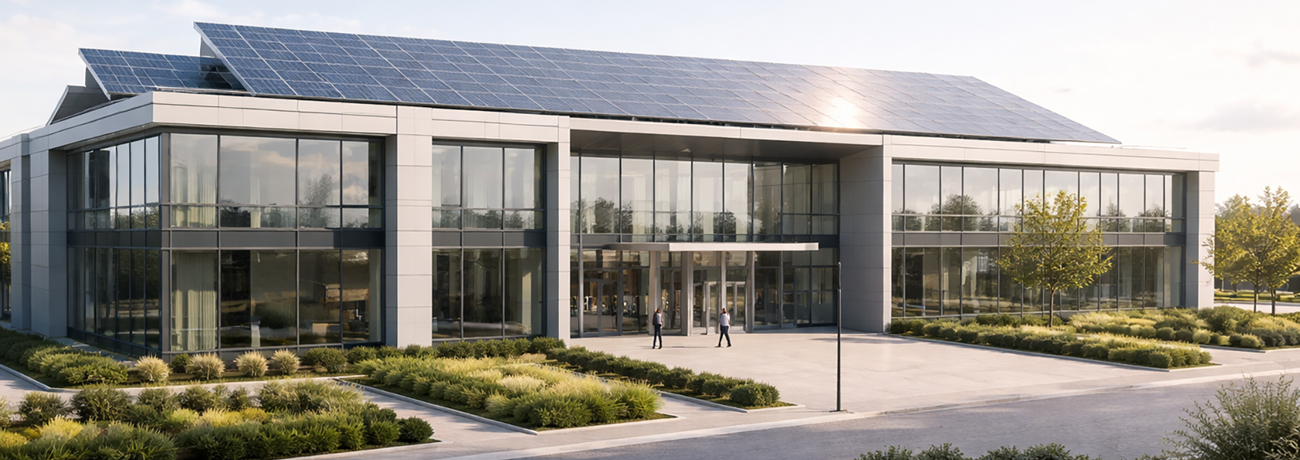
Manufacturing sites tend to use large amounts of electricity, often throughout the working day. That alone makes them worth looking at. Where machines, production lines and support systems run during daylight hours, solar generation can be used directly rather than exported.
That said, factories are not simple environments. Loads vary, processes change, and energy use is rarely smooth. A system that works well on paper may behave differently once tied into real production activity.
The opportunity is there, but it needs handling carefully.
Factories rarely have steady demand. Equipment starts and stops, heating cycles kick in, compressors run intermittently, and different parts of the site may operate at different times. This creates peaks and troughs rather than a flat profile.
If most activity happens during daylight, solar can offset a meaningful portion of that demand. If shifts extend into evenings or nights, the overlap reduces, and more of the load sits outside solar generation hours.
It is not just about how much electricity is used. It is about when it is used.
Sites operating mainly during daylight tend to use solar energy more directly.
More predictable loads are easier to match with generation patterns.
Industrial buildings often provide space for meaningful system sizes.
Even then, each site behaves differently. Two factories with similar buildings can have very different energy profiles.
Heavy machinery can create sharp demand spikes that solar alone does not fully address. A production line starting up may draw far more power than the panels can provide at that moment.
Processes that run overnight or in extended shifts also reduce the proportion of energy that can be supplied directly by solar. In these cases, solar still contributes, but it may not align as neatly with demand.
Space constraints, roof condition and structural limits can also affect how much capacity can be installed.
Factories do not stop easily. Installation has to be planned around production schedules, safety requirements and access restrictions. Lifting equipment, roof access and electrical integration all need careful coordination.
Work is often phased to avoid disrupting operations. That may mean longer installation periods but fewer interruptions to production. Internal electrical work, particularly where systems are integrated with existing infrastructure, can be more involved than the rooftop installation itself.
It is a project that sits alongside day-to-day operations rather than replacing them.
In many cases, yes. Where daytime demand is strong, solar can offset a portion of grid electricity directly. Over time, that can reduce exposure to rising energy costs.
The scale of that reduction depends on how closely generation matches demand. A site running heavily during daylight may see a stronger impact than one operating across longer hours.
It is not usually a complete solution, but it can form a substantial part of a broader energy approach.
Storage can support solar by shifting energy into later periods, but its role often extends beyond that. It can also help manage short demand spikes, which are common in manufacturing environments.
However, storage adds cost and complexity. Its value depends on how the site operates and whether those spikes or timing differences are significant enough to justify it.
Some factories benefit from it. Others find that operational changes achieve similar results.
Maintenance tends to be straightforward, but access is important. Large roofs need safe routes for inspection, and industrial environments can introduce dust or debris that affects performance over time.
Regular checks and occasional cleaning are usually enough to keep systems operating as expected. Poor access, on the other hand, can lead to maintenance being delayed.
It is not a major burden, but it should not be overlooked.
If most production takes place outside daylight hours, the direct benefit of solar reduces. If the roof cannot support the system or is due for replacement, installation may not make sense in the short term.
Grid constraints can also limit system size, particularly where export capacity is restricted. In these situations, other measures such as efficiency improvements or demand management may take priority.
Solar works best where the building and the operation both support it.
Start with the energy profile. Look at how electricity is used across the day, where peaks occur and how consistent the load is. Then consider the building itself, roof condition, available space and any constraints.
This usually reveals whether solar is likely to contribute meaningfully and what sort of system might be appropriate. From there, more detailed design and cost discussions can follow.
Understanding the process often matters more than the size of the roof.